
An AI manhua expression sheet compares different performances of the same character. Start with one approved identity, a consistent camera angle, and similar lighting. Then vary the expression and review each result. A nine-panel layout makes comparison convenient; it does not guarantee nine matching faces in a single request.
Our example is Lin Lan, an original investigator searching an old city for a missing cassette. Her scenes need alertness, suspicion, and restrained sadness, so the sheet should do more than collect generic smiling, angry, and crying faces. Choose emotions from the script before filling the grid.
The images and prompts in this guide are teaching examples. They are not product benchmarks or promises of automatic consistency. The workflow concerns still-image expression reference, not voice acting, animation, or lip-sync generation.
What an AI manhua expression sheet should preserve
Expressions move the brows, eyelids, mouth, and facial tension. They should not casually redesign the jaw, eye spacing, hairline, or apparent age. A dramatic expression that looks like another person is a failed identity reference even if the emotion itself is easy to recognize.
Define intensity as well as emotion. Mild suspicion might use a focused gaze and a small brow contraction. Shock might open the eyelids and mouth much further. Merely changing the mouth from closed to open does not explain every emotional distinction a dialogue scene needs.
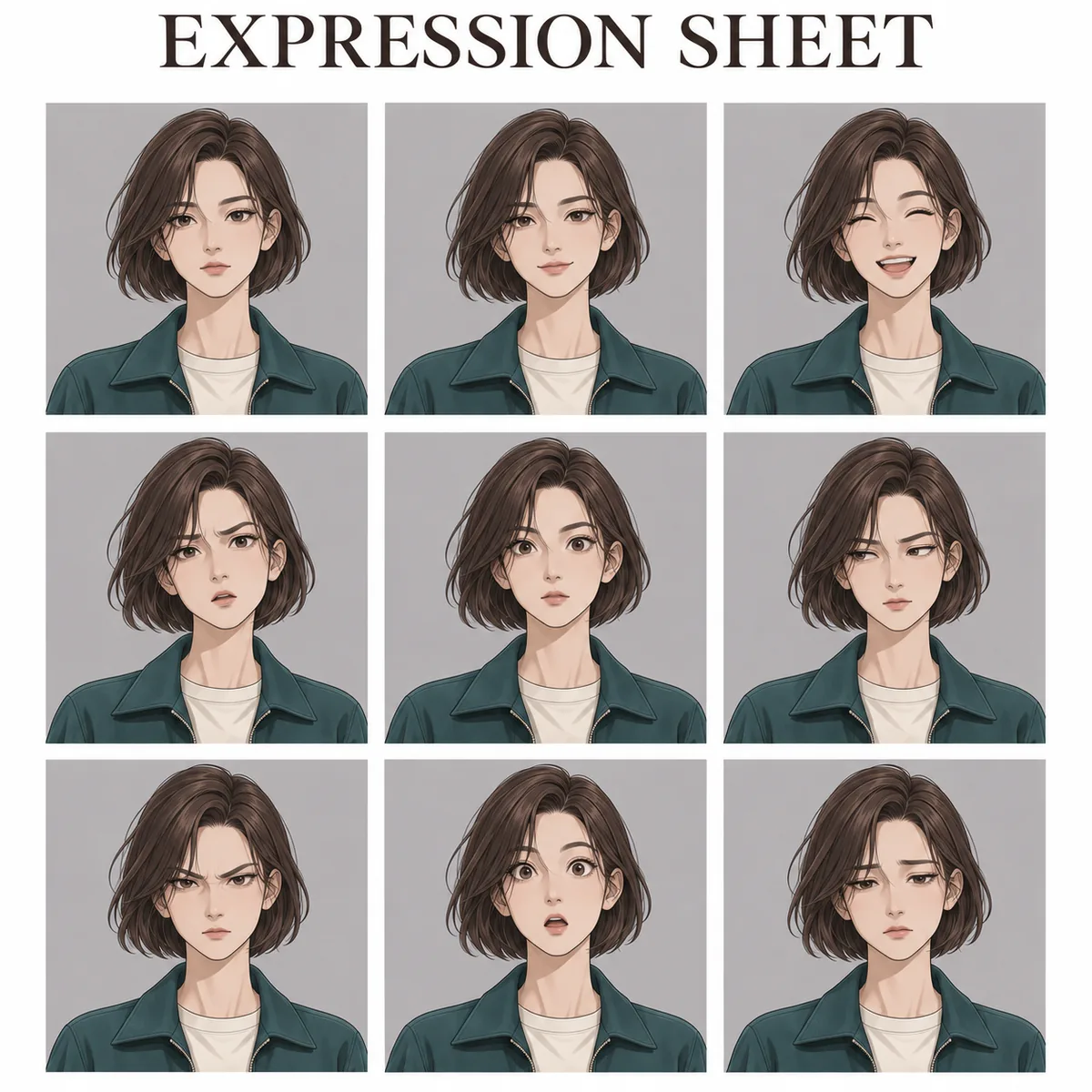
AI-generated teaching illustration: compare brow, eye, and mouth performance under similar framing, then verify identity separately.
1. Choose emotions from the episode
Build the grid around a neutral baseline, common reactions, and story-specific states. Neutral gives you a comparison anchor. The remaining panels should answer production needs rather than repeat several nearly identical smiles to fill empty space.
| Emotion group | Performance focus | Story use |
|---|---|---|
| Neutral, slight smile, happy | Mouth corners and relaxed eyelids | Conversation and changing relationships |
| Confused, alert, suspicious | Brow shape, gaze and facial tension | Clues, unfamiliar sounds and questioning |
| Angry, surprised, restrained sadness | Intensity without changing the face design | Conflict, revelation and disappointment |
Replace an emotion when the story calls for it. An exhausted detective may need fatigue and relief more than cheerful excitement. A minor character might only need neutral, one common reaction, and one strong response. Nine panels are a presentation choice, not a universal emotional taxonomy.
For subtle states, write the situation beside the emotion in your working notes. “Suspicious after hearing an inconsistent alibi” tells a collaborator more than “suspicious.” Keep that narrative cue separate from the persistent appearance block so it can change without rewriting identity.
2. Hold framing steady and specify every cell
Choose a front view or a modest three-quarter angle for the first sheet. Use the same crop, face size, background, and lighting. When every cell changes camera direction, it becomes difficult to decide whether differences come from acting, perspective, or identity drift.
Approve the base first with the character design guide. Then use an available reference-input workflow rather than assuming that mentioning a reference in text automatically supplies one.
Task: Make an expression reference for the supplied original character.
Identity: Lin Lan, adult woman aged 24, narrow face, chin-length dark
brown bob, teal cropped jacket and ivory shirt.
Layout: 3 by 3 grid, one chest-up portrait per cell, same front angle
and comparable face size.
Row 1: Neutral, slight smile, happy.
Row 2: Confused, alert, suspicious.
Row 3: Angry, surprised, restrained sadness.
Preserve: Face shape, eye spacing, hairline, haircut and adult age.
Vary: Brows, eyelids, mouth and facial tension.
Treatment: Pale gray background, even lighting, clear 2D acting reference.
Avoid: Hands covering the face, complex props, meme text and extreme distortion.
If a combined request repeats cells, changes the order, or loses identity, test three emotions first or generate them separately. Do not include an obviously different face just to finish a complete grid. A smaller accepted set is a more reliable starting point than a polished but contradictory board.
3. Review identity before performance
Temporarily ignore the emotion labels and compare the forehead, jaw, nose, hairline, and haircut. Look for abrupt changes in age or facial proportions. This first pass prevents an expressive image from earning approval simply because its acting distracts from a different identity.
Then review the emotions. Hide the labels and ask a collaborator what each face communicates. If alert and suspicious are indistinguishable, you may need a more specific gaze or brow relationship, not a stronger version of every facial movement at once.
Do not require all emotions to use the same visible amount of teeth, eye opening, or mouth movement. Those are legitimate performance variables. The useful boundary is whether the expression remains readable while the underlying character is still recognizable.
4. Test the sheet in a dialogue panel
Choose a real conversational beat and describe its trigger plus the visible response. For example: “On hearing the cassette mentioned, her brows tighten slightly, the smile stops, and her gaze holds on the other speaker.” That gives a reviewer a concrete intention beyond the label “concerned.”
Keep framing in mind. A long shot may need posture and head direction to communicate what a close-up can show through a small change around the eyes. Do not compensate for a weak wide shot by exaggerating the facial features until the character becomes unrecognizable.
If a new angle changes identity, follow the character consistency guide. Repair the angle or reference gap before changing the approved base face to accommodate one expression. Keep the original neutral reference available throughout the process.
5. Make revisions small and record the result
When a portrait largely works, inspect the options available in the image editor for a targeted revision. State whether the problem is a brow, mouth shape, gaze, or intensity. After editing, inspect nearby cheeks, nose, hair edges, and clothing; a local request still needs a full visual check.
Save accepted expressions with the character version and intended use. A filename such as lin-lan_v01_suspicious_front.png helps prevent a draft from being mistaken for an approved reference. Record whether an expression is subtle, strong, or reserved for a specific stylized sequence.
Keep a separate exaggerated-performance set if the story switches into comedy. That makes deliberate distortion understandable rather than leaving collaborators to guess whether a larger eye or flattened face is an error or a style choice.
Frequently asked questions
Is an expression grid better than separate portraits?
The grid is easier to compare and hand off, while separate portraits are easier to inspect and revise at larger size. You can approve portraits individually and arrange them afterward. The final criterion is clear acting and stable identity, not the number of cells.
Why does a new expression look like a different person?
A reference may be unclear, the angle may have changed, or the prompt may also have altered age and style. Return to a neutral baseline in matching light and inspect structure. Similar hair color alone does not establish that the face remains consistent.
Can this sheet drive lip sync?
An emotion reference is not a phoneme mouth chart or an automatically rigged animation asset. Follow the requirements of the actual downstream animation or lip-sync tool. This guide and the site's image tools do not promise those video-production capabilities.
How should exaggerated comedy expressions be handled?
Create a labeled variant with an agreed range of distortion, while preserving the ordinary sheet as the identity reference. Explain which scenes can use that variant. This keeps intentional cartoon performance from silently changing the design standard for every serious dialogue shot.
Record the accepted set in the character template, then use the expression-sheet tool to begin working on the reactions your next episode actually needs.